From Your Feet to Your Pelvic Floor: How Your Body Works Together
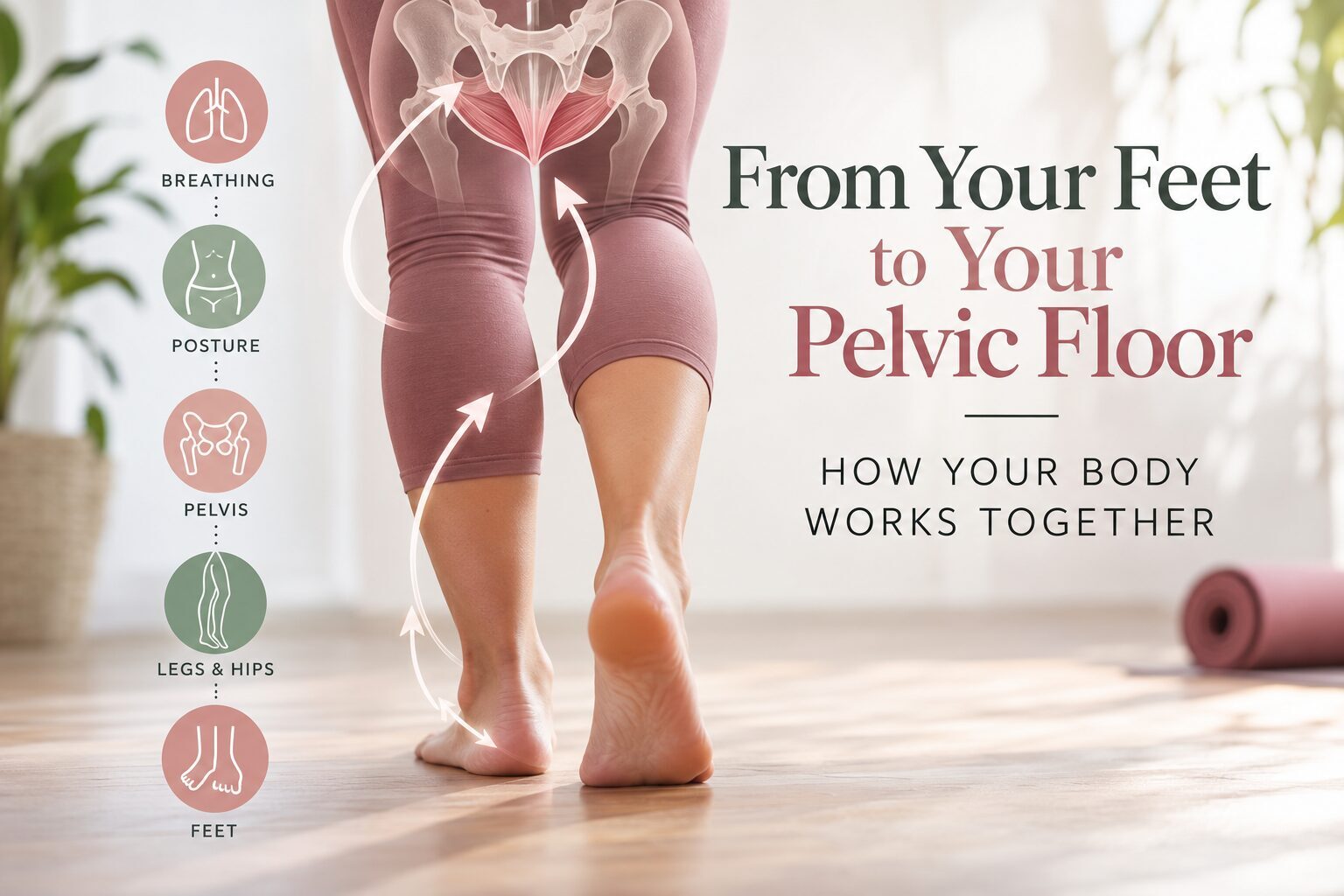
What scientific research tells us about the surprising connection between your feet, posture, and pelvic floor muscles.
Have you ever thought about what your feet have to do with your pelvic floor?
Probably not!
We spend so much time thinking about our abdominal muscles, posture, and pelvic floor that we often forget where movement begins: at our feet.
But our bodies don't work in isolated pieces. When we stand, walk, squat, or lift, our muscles and joints work together to maintain balance, distribute forces, and support movement.
So, could the position of your feet actually influence your pelvic floor?
Interestingly, research suggests that it can.
Let's explore the science behind this connection.
1. Your Body Is One Connected System
Imagine your body as a building.
Your feet provide the contact with the ground. Your legs and hips help control movement. Your pelvis connects your lower body to your trunk, while your pelvic floor contributes to organ support and continence.
When you change the position of one part of your body, other parts may adjust.
For example, changing your ankle position can influence your standing posture and pelvic alignment.
Researchers have investigated whether these changes also influence pelvic floor muscle activity.
And the results are interesting.
2. What Does Science Say About Your Feet and Pelvic Floor?
A study published in The Journal of Urology in 2009 examined 31 women performing pelvic floor muscle contractions in different ankle positions.
Researchers measured pelvic floor muscle electrical activity using electromyography (EMG).
They found that changing ankle position influenced the measured muscle activity during pelvic floor contractions.
Certain positions produced greater electrical activity than standing with the feet flat.
This suggests that foot and ankle positioning may influence how the pelvic floor muscles respond during exercise.
However, there's an important distinction.
Greater muscle activation does not necessarily mean greater strength or better pelvic floor function.
The study measured immediate electrical activity, not whether changing foot position improved long-term symptoms or prevented urinary leakage.
These findings are promising, but further research is needed.
3. Does Your Posture Influence Your Pelvic Floor?
Your pelvic floor works in different positions throughout the day.
Think about how often you change position:
Sitting at your desk.
Standing in the kitchen.
Squatting to pick up your child.
Walking or running.
Lifting groceries.
Your pelvic floor needs to respond to different demands during each activity.
A 2023 systematic review and meta-analysis examined 11 studies investigating pelvic floor muscle function in different body positions.
Researchers found that some measurements of pelvic floor activity and movement differed between standing, sitting, and lying down.
Interestingly, maximum voluntary contraction measurements did not consistently differ between standing and lying down.
This tells us something important:
Body position can influence certain aspects of pelvic floor function, but there isn't one perfect position for everyone.
Good pelvic floor training should eventually prepare you for the movements you perform in everyday life.
4. What About the Connection Through Fascia?
Fascia is connective tissue that surrounds, separates, and supports muscles and other structures throughout the body.
It plays an important role in how tissues interact and transmit forces.
The pelvic floor is supported by muscles, ligaments, and connective tissues that contribute to the function of the pelvis.
However, you may have heard claims that a specific fascial connection runs from your feet directly to your pelvic floor and that stretching your feet can therefore fix pelvic floor problems.
This is where we need to be careful.
Although the body contains interconnected muscular and connective-tissue structures, there is currently insufficient clinical evidence to conclude that foot stretching alone improves pelvic floor dysfunction through a particular fascial pathway.
Understanding these connections can be useful, but they shouldn't replace evidence-based pelvic floor assessment and training.
5. Why Whole-Body Movement Matters
Your pelvic floor doesn't function independently of the rest of your body.
Research has also investigated how the pelvic floor and abdominal muscles activate together.
A 2019 systematic review examined 20 studies involving pelvic floor and abdominal muscle co-contraction.
The findings suggest that these muscle groups can work together, although the precise patterns and clinical significance remain uncertain.
This is one reason pelvic floor education can be combined with appropriate whole-body movement.
Rather than thinking about one muscle in isolation, we can learn how our bodies coordinate during everyday activities.
6. Try This: A Simple Foot and Posture Awareness Exercise
Here's a gentle exercise to explore how your body responds to changes in standing position.
Step 1: Find your balance
Stand barefoot on a comfortable, stable surface.
Notice three points of contact beneath each foot: your heel, the base of your big toe, and the base of your little toe.
Step 2: Shift your weight
Slowly move your weight slightly forward and backward.
Notice how your ankles, knees, hips, and trunk respond.
Step 3: Return to a comfortable position
Find a balanced standing position without locking your knees or forcing your pelvis into a particular alignment.
Step 4: Add breathing
Take five relaxed breaths, allowing your rib cage to expand naturally.
Avoid holding your breath or deliberately pushing downward through your pelvic floor.
Step 5: Notice the difference
Do you feel more aware of your balance? Has your posture changed? Does standing feel different?
This is an awareness exercise, not a proven treatment for pelvic floor dysfunction.
Its purpose is to help you explore how different parts of your body work together.
7. The Cochrane Mama Philosophy: Strength From Within
At Cochrane Mama, we believe that understanding your body is an important part of becoming stronger.
Our approach to pelvic floor education and women's fitness focuses on more than isolated exercises.
We explore breathing, posture, body awareness, muscle coordination, and appropriate movement.
Whether you're pregnant, recovering after childbirth, or returning to fitness later in life, developing a better understanding of your body can help you approach exercise with greater confidence.
Your pelvic floor is part of a larger movement system, and learning how that system works is a valuable part of your fitness journey.
Final Thoughts
So, are your feet connected to your pelvic floor?
Yes, in the sense that foot position, posture, and pelvic floor muscle activity can influence one another during movement.
But does changing your foot position automatically strengthen your pelvic floor or cure bladder leakage?
No. Current research doesn't establish that.
What we do know is that the pelvic floor works alongside other muscles to support movement and everyday function.
And sometimes, learning to understand your body is just as important as learning a new exercise.
At Cochrane Mama, we don't just focus on getting stronger. We focus on understanding how your body works, from the ground up.
Explore our pelvic floor education, pre- and postnatal health and fitness, and women's fitness programs at www.cochranemama.org.
Educational information only. Persistent pelvic pain, urinary leakage, or pelvic pressure should be assessed by a qualified healthcare professional.
Scientific References
1. Chen HL et al. (2009).
The Effect of Ankle Position on Pelvic Floor Muscle Contraction Activity in Women.
The Journal of Urology, 181(3), 1217–1223.
https://doi.org/10.1016/j.juro.2008.10.151
2. Huang et al. (2023).
Most of the pelvic floor muscle functions in women differ in different body positions, yet others remain similar: systematic review with meta-analysis.
Frontiers in Medicine.
https://doi.org/10.3389/fmed.2023.1252779
3. Pelvic floor and abdominal muscle cocontraction in women with and without pelvic floor dysfunction (2019).
Systematic review and meta-analysis.
Clinics.
https://doi.org/10.6061/clinics/2019/e1319